
In a world of constant stimulation, endless to-do lists, and an overwhelming stream of digital information, journaling offers a return to stillness—a sacred space where your inner voice can be heard, honored, and explored. Far more than a diary or record of events, journaling is a tool for self-reflection, healing, and personal transformation.
When approached intentionally, journaling becomes an art form—one that supports growth across all aspects of your being. It helps you map your inner world, gain clarity, track emotional patterns, and align your daily life with your values and aspirations.
In this article, we will explore journaling not just as a personal practice, but as a powerful tool for holistic wellness. We’ll look at how journaling nurtures the seven dimensions of wellness—emotional, spiritual, physical, intellectual, social, environmental, and occupational—and offer a variety of techniques to support your journey of self-discovery and growth.
What Is Holistic Wellness?
Holistic wellness is the integration of mind, body, and spirit, recognizing that well-being is multidimensional and interconnected. True wellness is not just about the absence of illness, but about living in alignment—emotionally fulfilled, spiritually connected, physically vital, and mentally sharp.
The seven dimensions of wellness provide a framework for balanced, intentional living:
- Emotional
- Spiritual
- Physical
- Intellectual
- Social
- Environmental
- Occupational
Journaling, when practiced with awareness, can touch all of these dimensions, helping you live with greater presence, authenticity, and purpose.
Why Journaling Matters
Journaling is one of the most accessible tools for personal growth. It requires little more than a notebook, a pen, and a willingness to be honest with yourself. Numerous studies have shown that journaling can reduce stress, improve immune function, boost mood, and enhance cognitive performance. But beyond science, journaling offers something deeply human: connection—with your emotions, your intuition, your truth.
By putting your thoughts on paper, you create space to observe them without judgment. You slow down. You reflect. You learn. And, over time, you evolve.
Let’s explore how journaling supports each of the seven dimensions of wellness and how you can tailor your practice to nourish your whole self.
1. Emotional Wellness: Journaling for Clarity and Healing
Emotional wellness is the ability to understand, express, and process your emotions in a healthy way. Journaling offers a safe container for emotional expression—a private space to vent, process, or simply acknowledge what you’re feeling.
Techniques to Try:
- Emotional Check-In: Start with “How am I feeling right now?” Let your response flow without censoring it.
- Trigger Tracker: Write about a recent emotional reaction and explore the underlying thoughts or unmet needs.
- Mood Mapping: Rate your mood each day and note any patterns or triggers over time.
Benefits:
- Reduces emotional reactivity
- Enhances self-compassion
- Encourages emotional literacy
Journaling allows you to meet your emotions with curiosity rather than avoidance. Over time, this builds emotional resilience and a greater capacity for self-regulation.
2. Spiritual Wellness: Journaling for Connection and Meaning
Spiritual wellness involves a sense of purpose, inner peace, and connection to something greater than yourself. Whether or not you follow a religious tradition, spirituality can be nurtured through quiet reflection, gratitude, and inquiry.
Techniques to Try:
- Gratitude Journaling: Write down three things you’re grateful for each morning or evening.
- Sacred Questions: Explore prompts like “What does my soul need today?” or “What truth am I being invited to live?”
- Synchronicity Log: Record moments of alignment, intuition, or awe to strengthen your spiritual awareness.
Benefits:
- Deepens personal insight
- Fosters a sense of connection
- Clarifies life values and direction
Spiritual journaling isn’t about finding all the answers—it’s about being willing to ask deeper questions and listen inward.
3. Physical Wellness: Journaling for Body Awareness and Self-Care
Physical wellness is more than exercise and nutrition. It’s about tuning in to your body’s signals, honoring your energy, and supporting recovery. Journaling helps you reconnect with your body as a source of wisdom rather than judgment.
Techniques to Try:
- Body Check-In: Write about how your body feels today. Where is there tension? Ease? Fatigue?
- Wellness Logs: Track sleep, hydration, movement, or energy levels alongside notes on emotional or mental states.
- Intuitive Eating Reflections: Note what you ate, how it made you feel, and whether it aligned with hunger or habit.
Benefits:
- Improves body awareness
- Encourages healthy habits
- Supports consistent self-care
By journaling your body’s needs, you shift from auto-pilot to conscious engagement—essential for long-term health.
4. Intellectual Wellness: Journaling for Curiosity and Growth
Intellectual wellness involves stimulating your mind, challenging your assumptions, and embracing lifelong learning. Journaling provides an outlet for organizing thoughts, developing ideas, and capturing insights from your daily experiences.
Techniques to Try:
- Stream-of-Consciousness Writing: Set a timer for 10–15 minutes and write nonstop to clear mental clutter.
- Idea Catcher: Keep a section of your journal for quotes, book insights, podcast takeaways, or creative sparks.
- Reflection Prompts: Write responses to “What am I learning about myself this week?” or “What new perspective have I gained?”
Benefits:
- Enhances mental clarity
- Encourages curiosity
- Strengthens problem-solving and decision-making
Your journal becomes a living record of your intellectual evolution—tracking not only what you learn, but how you integrate it.
5. Social Wellness: Journaling for Relationships and Communication
Social wellness is nurtured through meaningful connections, healthy boundaries, and emotional availability. Journaling offers a way to process interpersonal experiences, prepare for difficult conversations, and celebrate moments of connection.
Techniques to Try:
- Relationship Reflections: Write about recent interactions. What went well? What felt challenging? What did you learn?
- Letters Unsent: Express your feelings to someone in writing, even if you don’t plan to send the letter. This can bring closure or clarity.
- Empathy Mapping: Put yourself in another’s shoes. What might they be feeling or needing?
Benefits:
- Enhances empathy and self-awareness
- Supports conflict resolution
- Strengthens communication skills
Through social journaling, you can explore the emotional landscapes of your relationships and deepen your understanding of human connection.
6. Environmental Wellness: Journaling for Presence and Connection to Place
Environmental wellness involves creating and engaging with spaces that nourish your well-being—both externally and internally. It’s about your physical environment, yes, but also about the energetic environments you move through.
Techniques to Try:
- Sacred Space Scan: Describe the spaces you spend time in. Do they support your energy or drain it?
- Nature Journaling: Spend time outdoors and write about what you see, hear, and feel. Note your sensory impressions and emotional shifts.
- Decluttering Reflections: Use journaling to explore why certain items or environments feel heavy or meaningful.
Benefits:
- Increases awareness of environmental impact
- Enhances presence and mindfulness
- Supports energetic clarity and simplicity
By aligning your physical surroundings with your inner values, you create environments that support your growth rather than hinder it.
7. Occupational Wellness: Journaling for Purpose and Alignment
Occupational wellness is about finding meaning and satisfaction in your work—whether paid or unpaid. Journaling helps you explore your values, set professional intentions, and reflect on your contributions and growth.
Techniques to Try:
- Work Wins: Record daily or weekly successes, big or small, to build confidence and motivation.
- Purpose Prompt: Ask, “How does my work align with my values?” or “What impact do I want to have through my work?”
- Burnout Check-In: Reflect on your workload, boundaries, and emotional investment in your job. Where do you need support?
Benefits:
- Clarifies purpose and direction
- Encourages balance and boundary-setting
- Enhances satisfaction and fulfillment
Journaling keeps your professional life aligned with your personal growth, helping you build a career or calling that feels congruent with your whole self.
How to Start and Sustain a Journaling Practice
Journaling doesn’t have to be complicated. The most important thing is consistency. You don’t need perfect grammar, long entries, or beautiful handwriting. Just show up. Let your truth spill onto the page. Trust the process.
Tips for Getting Started:
- Choose a dedicated journal and pen that you enjoy using.
- Create a ritual around journaling—same time, same place, perhaps with tea or music.
- Start small—5 to 10 minutes a day is enough to begin noticing shifts.
- Use prompts when you’re stuck. Keep a list of favorites or choose a new one each week.
- Don’t edit or judge your writing. This is your space to be raw and real.
- Review past entries periodically to track growth, patterns, and insights.
Sample Weekly Journaling Plan (Aligned with the 7 Dimensions):
- Monday: Emotional check-in
- Tuesday: Spiritual reflection or gratitude list
- Wednesday: Physical wellness tracker
- Thursday: Intellectual free write
- Friday: Social insight or letter unsent
- Saturday: Environmental observation in nature
- Sunday: Career alignment or weekly wins review
This rhythm helps you engage with all areas of wellness without becoming overwhelmed or rigid.
Final Thoughts
Journaling is one of the most transformative self-care tools available to us. When practiced intentionally, it becomes a bridge between your conscious thoughts and your deeper wisdom. A mirror that reflects both your challenges and your capacity for healing. A sanctuary where you return to your truth again and again.
By engaging with journaling through the lens of the seven dimensions of wellness, you create not just a habit, but a holistic practice. A practice that doesn’t just track your life, but shapes it. One that fosters not only self-expression but self-evolution.
Start with one page. One feeling. One question. Let your journal become the place where you remember who you are and who you are becoming.
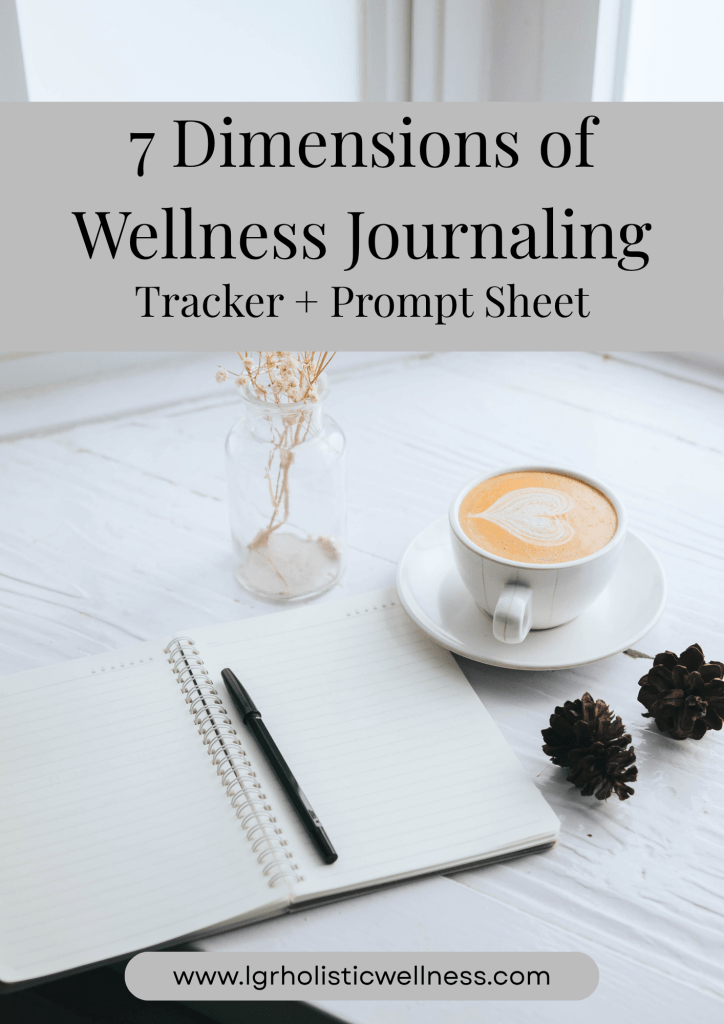
Ready to reconnect with yourself and bring more balance into your life?
Download the 7 Dimensions of Wellness Journaling Tracker + Prompt Sheet—your free guide to uncovering insights, fostering self-discovery, and building a more centered, intentional you. With reflective prompts and a simple tracking system, this tool helps you nurture every part of your well-being.
✨ Grab your free copy now and start journaling your way to lasting growth and balance!






 LGR Holistic Wellness
Leave a comment